NUCLEOTIDE DATA
NCBI GenBank
An archival resource for publicly available annotated nucleotide sequences and associated information.
Visit GenBank →BIOINFODATA / SCIENTIFIC DATA INFRASTRUCTURE
From a DNA sequence to a protein structure, reliable biological discovery begins with knowing where data come from, what they represent, and how they connect.
Explore Database Directory →01 / THE FOUNDATION OF DATA-DRIVEN BIOLOGY
Biological databases are organized resources that store, describe, and make available information about biological molecules, organisms, experiments, and scientific knowledge. They allow researchers to compare findings, retrieve reference sequences, examine annotations, and investigate experimental evidence produced by other laboratories.
Some databases function primarily as repositories for submitted data. Others provide curated knowledge assembled from published experiments, expert interpretation, or computational annotation. This distinction matters: a deposited sequence can document an experimental observation, while an annotated protein function may represent a mixture of experimental findings and computational predictions.
These resources form a connected research ecosystem. A genomic sequence may link to a gene annotation, its encoded protein, a predicted or experimentally determined molecular structure, and publications describing its biological function.
Submitted sequences, molecular measurements, and experimental datasets.
Reviewed annotations, biological relationships, and structured scientific interpretation.
Identifiers and links connecting records across scientific resources.
02 / DATABASE DIRECTORY
Each database has a particular role. The best starting point depends on whether the research question involves a reference sequence, protein annotation, molecular structure, gene-expression experiment, or functional pathway.
NUCLEOTIDE DATA
An archival resource for publicly available annotated nucleotide sequences and associated information.
Visit GenBank →GENOME ANNOTATION
Reference genomes, gene models, transcripts, variation resources, and comparative genomic information.
Visit Ensembl →PROTEIN KNOWLEDGE
Protein sequences, function-related annotations, sequence features, and evidence-backed references.
Visit UniProt →MOLECULAR STRUCTURES
Access experimentally determined three-dimensional structures of proteins, nucleic acids, and molecular complexes.
Visit RCSB PDB →GENE EXPRESSION
A repository for functional genomics studies, including gene expression and other high-throughput datasets.
Visit GEO →SEQUENCING ARCHIVE
Explore sequencing-run records and publicly accessible high-throughput sequencing data.
Visit SRA →03 / FINDING THE RIGHT RESOURCE
Choosing a biological resource should begin with the data type and scientific question. A researcher seeking a protein's function needs different evidence from one investigating raw RNA-seq reads. Some projects require several databases because no single repository contains all necessary molecular information.
| Research question | Starting resource | What to examine |
|---|---|---|
| What is the reference sequence of a gene? | GenBank / Ensembl | Sequence version, genomic coordinates, transcript model |
| What does a protein do? | UniProt | Functional annotations and evidence |
| Is a molecular structure available? | RCSB PDB | Structure method, resolution where applicable, chains |
| Where can I find gene expression studies? | GEO | Study design, samples, platforms, processing |
| Where can I find raw sequencing runs? | SRA / ENA | Run accessions, library strategy, files, metadata |
04 / ACCESSION NUMBERS
An accession number is a stable identifier assigned to a database record. It helps researchers refer to a specific sequence, protein, structure, study, or experimental run without relying only on names, which can be ambiguous or change over time.
Identifiers also allow records to be connected. A protein record may link to a gene, an experimental structure, a biological pathway, and scientific literature. These cross-references support data integration, but researchers must check whether the linked records describe the same organism, isoform, assembly, or biological context.
When publishing a sequence-based analysis, reporting the exact reference accession and version helps others reproduce coordinate mapping and annotation. A gene symbol alone is usually not sufficient to identify a precise reference record.
05 / OPEN SCIENCE AND REUSE
FAIR describes four goals for scientific data stewardship: Findable, Accessible, Interoperable, and Reusable. These principles encourage persistent identifiers, informative metadata, documented access methods, standardized formats, and clear conditions for reuse.
FAIR does not mean every dataset must be publicly downloadable. Sensitive human research data may require controlled access while still being discoverable through appropriate metadata and governance procedures. Responsible reuse must consider consent, licensing, privacy, provenance, and the scientific limitations of the original study.
Records can be located through metadata and identifiers.
Access conditions and retrieval procedures are defined.
Formats and vocabularies support linking systems.
Provenance, documentation, and use conditions are clear.
06 / SCIENTIFIC DATA IN CONTEXT
Public databases enable research at scales that individual laboratories cannot always achieve. Scientists can combine independent genomic studies, compare protein annotations between organisms, and examine molecular evidence across experiments. Yet differences in sampling, processing, annotation, and measurement technologies can introduce bias.
The most reliable analyses begin by evaluating whether datasets are scientifically comparable. Sample origin, organism, biological condition, reference assembly, processing pipeline, and metadata completeness all influence what can be inferred.

07 / INTEGRATING DIFFERENT DATA TYPES
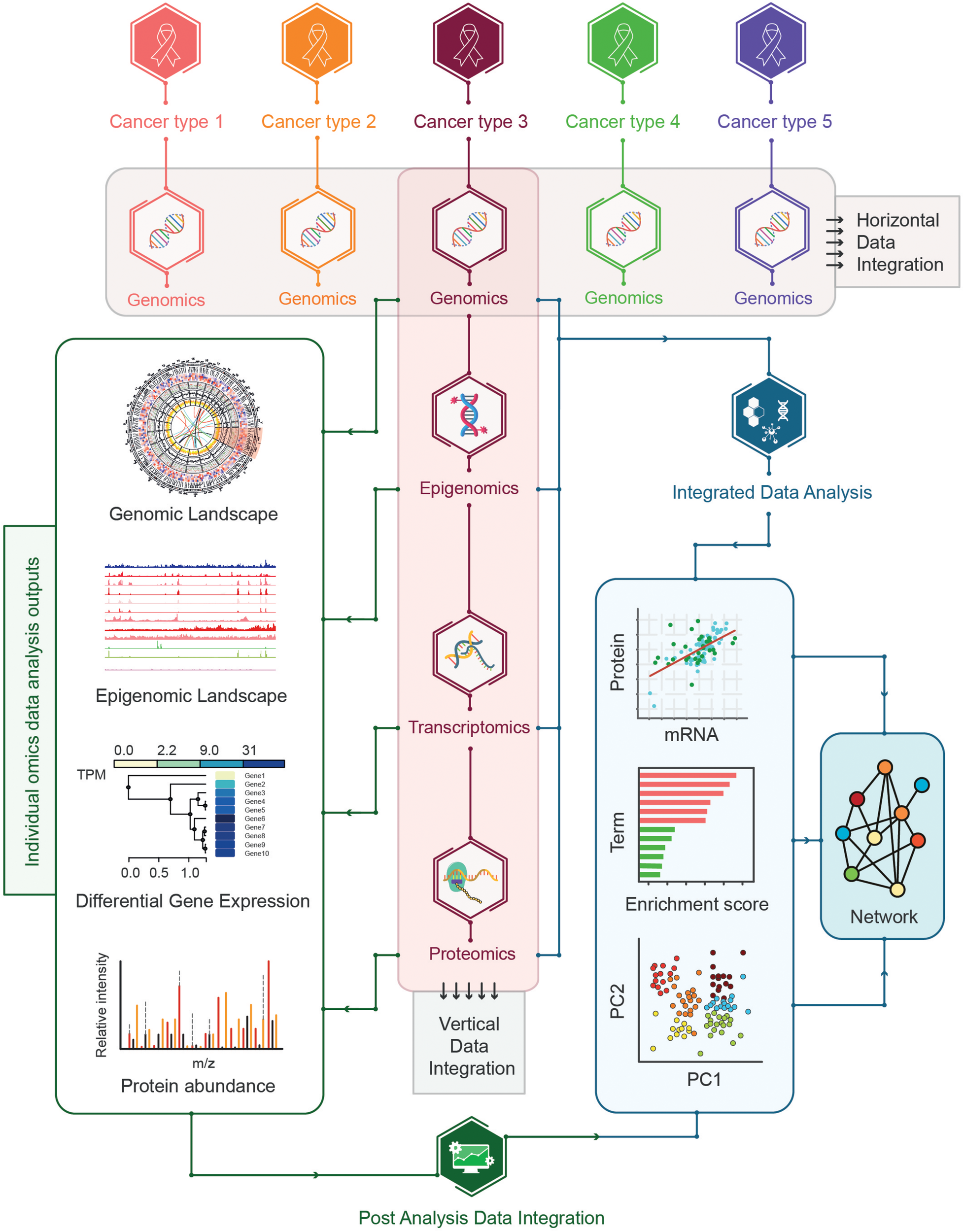
Different biological resources often describe complementary layers of the same system. Genomics identifies DNA sequences and variation; transcriptomics investigates gene expression; proteomics provides measurements and annotations related to proteins. Researchers can combine these layers to ask whether a genomic difference is associated with altered RNA abundance, protein behavior, or a biological pathway.
Cross-database integration requires careful identifier mapping. Multiple transcripts may correspond to one gene, proteins may have several isoforms, and reference annotations change between releases. Integrating results without accounting for these relationships can create misleading matches.
08 / ADDITIONAL RESEARCH RESOURCES
Beyond large general-purpose databases, specialized resources provide experimental data, pathway information, and domain-specific annotations.
09 / FREQUENTLY ASKED QUESTIONS
A biological database is an organized resource containing information about sequences, molecules, experiments, organisms, or biological knowledge, typically with identifiers and searchable metadata.
UniProt focuses on protein sequences and biological annotations. The Protein Data Bank archives experimentally determined three-dimensional macromolecular structures and their associated information.
NCBI GEO provides functional genomics study records and processed data, while sequencing reads may be available through linked SRA records or related archives.
No. Databases differ in curation policies, and individual annotations can be experimental, computational, or inferred. Always examine evidence types and source documentation.
10 / CONNECTING BIOLOGICAL KNOWLEDGE
Biological databases turn individual experiments into reusable scientific resources. Their strength comes from accurate metadata, transparent provenance, interoperable identifiers, and responsible interpretation. When data can be meaningfully connected across genomics, proteomics, structures, and pathways, researchers gain new opportunities to investigate biological mechanisms and develop biotechnology applications.