DNA Sequencing Explained: From Sanger Sequencing to Next-Generation and Long-Read Technologies
Explore how DNA sequencing evolved from the pioneering Sanger method to high-throughput next-generation sequencing and modern long-read technologies, with explanations of their scientific principles, differences, limitations, and applications in biotechnology.
DNA Sequencing Explained: From Sanger to NGS and Long Reads
From reading one DNA fragment at a time to reconstructing entire genomes, discover the technologies that changed how scientists explore the molecular foundations of life.
DNA sequencing determines the order of nucleotide bases in a DNA molecule. Over several decades, sequencing advanced from reading relatively short DNA fragments individually to producing enormous numbers of reads in parallel and, more recently, reading long stretches of single DNA molecules. Each technological advance has opened different scientific questions while introducing new analytical challenges.
What Is DNA Sequencing, and What Does It Reveal?
DNA stores hereditary information in a sequence of four nucleotide bases: adenine (A), thymine (T), cytosine (C), and guanine (G). DNA sequencing is the experimental process of determining their order in a DNA molecule. This seemingly simple achievement has transformed biological research because differences in nucleotide sequences can influence genes, regulatory regions, chromosome organization, and evolutionary relationships.
Imagine two bacterial isolates that appear similar under a microscope. Sequencing their genomes may reveal differences in metabolic genes, mobile genetic elements, or genes associated with antimicrobial resistance. Scientists can use these observations to investigate how the isolates are related and whether they possess different biological capabilities. The sequence itself provides evidence, but the actual phenotype still depends on gene activity and biological context.
DNA sequencing is used at multiple scales. Researchers may sequence a single PCR product to verify its identity, examine a selected group of genes, characterize the protein-coding regions of a genome, or investigate the entire genome. Sequencing also supports microbial community studies, evolutionary research, agricultural genetics, and investigations of human genetic variation.
An important distinction is that sequencing does not directly reveal everything an organism is doing. It identifies sequence information, while additional experiments may be needed to determine how that information influences RNA expression, protein activity, and observable traits. Bioinformatics provides the computational tools needed to move from sequence measurements toward biological interpretation.
The ability to read DNA emerged through decades of molecular research. One particularly influential innovation arrived in the 1970s and became the foundation of modern sequence analysis: the Sanger method.
The Sanger Breakthrough: Making DNA Readable
Before routine DNA sequencing, scientists could investigate genes through biochemical experiments and genetic analysis, but obtaining their complete nucleotide sequences was difficult. In 1977, Frederick Sanger and colleagues introduced a chain-termination sequencing method that provided a practical way to determine DNA sequence order. Another DNA sequencing approach, developed by Maxam and Gilbert, was also reported during this period. Sanger sequencing became widely adopted because the method proved suitable for automation and many laboratory applications.
Early sequencing experiments required careful preparation of DNA templates and interpretation of fragment patterns separated by electrophoresis. Over time, advances in fluorescent labeling, capillary electrophoresis, and automated detection made the procedure faster and more accessible. Instead of manually interpreting a gel, researchers could examine digital electropherograms showing fluorescence peaks associated with individual nucleotide bases.
Sanger sequencing was important to the history of large-scale genome research, including the Human Genome Project. Automated capillary sequencing, combined with computational assembly, helped researchers reconstruct long genomic sequences from many overlapping DNA fragments. This required both laboratory innovation and increasingly sophisticated bioinformatics.
Today, Sanger sequencing remains useful for targeted applications. Researchers commonly use it to confirm plasmid sequences, inspect a PCR product, verify a molecular construct, or examine a specific region of a gene. Its main limitation is not that it has become scientifically irrelevant, but that processing very large numbers of independent DNA fragments is less efficient than with massively parallel methods.
To understand why Sanger remains useful, it helps to examine the chemistry responsible for converting a DNA template into a readable sequence.
How Sanger Sequencing Works: The Principle of Chain Termination
Sanger sequencing relies on DNA polymerase, the enzyme responsible for synthesizing DNA strands. During a sequencing reaction, DNA polymerase extends a primer along a template strand by adding complementary nucleotides. In addition to ordinary nucleotides, the reaction contains modified nucleotides called dideoxynucleotides, or ddNTPs.
The crucial feature of a ddNTP is the absence of the 3′ hydroxyl group required to extend a growing DNA strand. When DNA polymerase incorporates one of these modified nucleotides, further extension stops. Because termination can occur at many positions, the reaction produces DNA fragments of different lengths that collectively encode the original sequence.
In modern fluorescent Sanger sequencing, the four types of terminating nucleotides carry distinguishable fluorescent labels. The DNA fragments are separated by capillary electrophoresis, generally according to their length. As fragments pass a detection point, the instrument records their fluorescence. Software converts the resulting signals into an ordered series of nucleotide calls, typically displayed as an electropherogram.

The result is generally a sequence extending across several hundred bases, sometimes approaching approximately 800–1,000 usable bases under suitable conditions. Read length and quality depend on factors such as template purity, primer specificity, sequence composition, and reaction performance. Mixed templates can produce overlapping peaks, complicating interpretation.
A researcher inserts a gene into a plasmid for protein expression. Sanger sequencing can verify that the intended coding sequence is present and identify unexpected substitutions or small insertions and deletions within the region successfully covered. This makes it a valuable quality-control method in molecular cloning.
Sanger sequencing excels when the target is relatively small and well defined. But a genome contains millions or billions of nucleotides, and biological studies increasingly require comparisons across many samples. Meeting that demand required an entirely different level of sequencing throughput.
The Next-Generation Sequencing Revolution
Next-generation sequencing, usually abbreviated NGS, changed the scale of genetic research by allowing enormous numbers of DNA fragments to be sequenced in parallel. Whereas conventional Sanger sequencing processes comparatively few fragments per instrument run, massively parallel approaches can generate millions or more individual sequence reads within a sequencing experiment.
This shift made comprehensive molecular studies increasingly practical. Scientists could investigate multiple genes simultaneously, sequence whole bacterial genomes, analyze human exomes, and study genomic variation across large sample collections. High-throughput sequencing also supported the expansion of transcriptomics, epigenomics, and metagenomics.
NGS is an umbrella term rather than one single chemical procedure. Several sequencing strategies have existed, including sequencing by synthesis, sequencing by ligation, and methods that detect chemical signals associated with nucleotide incorporation. Modern short-read sequencing often uses massively parallel sequencing-by-synthesis approaches in which individual DNA fragments are read over repeated cycles.
One major advantage is the ability to obtain extensive sequence coverage. If many reads independently cover the same region, computational analysis can use their combined evidence to identify sequence differences and assess uncertainty. However, more reads do not automatically resolve every genomic region: repeated sequences, technical biases, and mapping ambiguity can remain problematic.
The arrival of NGS therefore changed both laboratory practice and computational biology. Researchers no longer needed only to produce accurate sequence measurements; they also needed reliable ways to manage large datasets, assess read quality, reconstruct genomes, and interpret complex sequence variation.
Understanding these analyses begins with a closer look at the stages that turn a biological sample into digital sequencing reads.
From DNA Samples to Millions of Sequence Reads
A typical short-read sequencing experiment begins with extracting DNA from a biological specimen. The extracted material is assessed for suitable quantity, quality, and integrity. DNA is then prepared as a sequencing library, usually by generating fragments and attaching short adapter sequences that support sequencing and, when needed, identification of individual samples.
Depending on the method, template molecules may be amplified to create groups of identical or closely related copies for signal detection. During sequencing-by-synthesis, nucleotide incorporation generates signals that are translated into base calls. These calls are accompanied by quality information estimating the confidence associated with individual nucleotide assignments.
Sequencing output commonly takes the form of FASTQ files containing read sequences and their associated quality scores. The data are then examined for characteristics such as base-quality distributions, adapter contamination, read-length patterns, and evidence of technical problems. Depending on the research question, reads may be aligned against a reference genome or assembled without one.

For variant discovery, alignment software identifies plausible genomic positions for reads. Variant-calling algorithms then examine the available evidence to distinguish sequence differences from sequencing errors and other artifacts. For a microbial genome without an adequate reference, assembly methods attempt to reconstruct longer contiguous sequences from overlapping reads.
Experimental design plays a decisive role throughout the process. Sequencing depth, library complexity, target enrichment, and sample quality influence the kinds of variants that can be reliably detected. A high-quality bioinformatics workflow improves interpretation, but it cannot recreate information that was never captured during the experiment.
This becomes particularly important when studying complex genomes, because the relatively short length of individual reads creates both opportunities and limitations.
Short-Read Sequencing: Its Strengths, Accuracy, and Blind Spots
Short-read sequencing typically generates DNA sequences ranging from tens to a few hundred nucleotide bases, depending on the platform and experimental configuration. Common applications use read lengths around 100–300 bases. Despite their limited length, short reads are extremely useful because they can be generated at high throughput with strong per-base accuracy and established computational analysis methods.
One strength is the detection of single-nucleotide variants and relatively small insertions or deletions in well-characterized genomic regions. With suitable sequence coverage, quality controls, and validated methods, short-read sequencing can provide highly informative variant profiles. It is also widely used for gene panels, exome studies, genome sequencing, and many microbial analyses.
However, a short read may not contain enough contextual information to identify its unique genomic origin. If a sequence occurs in several similar locations, computational alignment can become ambiguous. Repetitive DNA, duplicated genomic segments, and highly similar genes are especially challenging.
Structural variants introduce another difficulty. These are larger genomic alterations, including deletions, duplications, inversions, insertions, and rearrangements. Short-read algorithms may infer their presence from unusual alignments, read depth, or discordant read pairs, but reconstructing the precise sequence and arrangement of a complex variant can be difficult.
Imagine a genome containing several nearly identical repeated sequences. A 150-base read entirely inside one repeat may align to multiple locations. A much longer read that spans the repeat and reaches unique neighboring DNA can provide the additional context needed to place it correctly.
Short-read sequencing remains a highly effective approach for many research questions. Its limitations do not make it obsolete; instead, they reveal why a complementary class of sequencing technologies became increasingly important. Those technologies focus on reading much longer stretches of DNA.
Long-Read Sequencing: Recovering the Context Hidden by Short Fragments
Long-read sequencing produces sequences extending across thousands, tens of thousands, or sometimes substantially more nucleotide bases in a single read. Rather than relying exclusively on many short fragments to infer a long genomic region, researchers can obtain sequence information that spans much larger portions of individual DNA molecules.
This ability is particularly valuable for repetitive regions and structural variants. A long read may cover both a complex genetic alteration and the distinctive sequences surrounding it, helping researchers determine its location and arrangement. Long reads also improve the reconstruction of haplotypes: combinations of genetic variants located on the same chromosome copy.
Another major application is genome assembly. When assembling a genome from scratch, computational methods must determine how sequence fragments fit together. Repeats can create uncertain connections, especially if fragments are shorter than the repeated regions. Long reads can bridge these repeats and increase the continuity of reconstructed genomic sequences.
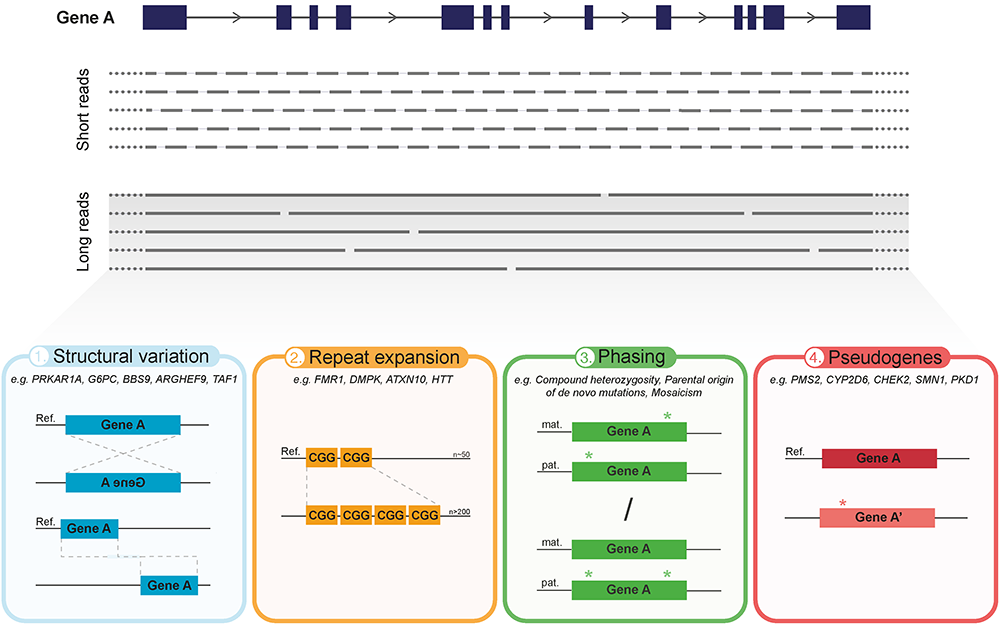
Long-read methods have also contributed to more complete human genome reference assemblies. The telomere-to-telomere research effort, for example, used advances in sequencing and assembly methods to resolve genomic regions that had remained challenging in earlier references. This work illustrates why read continuity is scientifically valuable even when a large amount of short-read data is already available.
Long-read sequencing is not free from limitations. Data accuracy, DNA input requirements, sequencing throughput, costs, and computational demands depend on the platform and protocol. Some applications benefit from combining long and short reads, using their different strengths to support sequence accuracy and genome reconstruction.
The term long-read sequencing includes more than one molecular detection principle. Two prominent approaches illustrate how different technologies can solve similar biological challenges through very different mechanisms.
How Single-Molecule Long-Read Technologies Work
Single-molecule real-time sequencing and nanopore sequencing are two major approaches used to generate long sequencing reads. Both can provide valuable continuity across complex DNA regions, but they detect nucleotide information using different physical processes.
Single-molecule real-time sequencing (SMRT) monitors DNA synthesis by a polymerase acting on an individual DNA template. Fluorescent signals associated with nucleotide incorporation are detected over time. One important development is circular consensus sequencing, in which repeated observations of a circularized DNA template are combined to produce a highly accurate consensus read, often referred to as a HiFi read.
Nanopore sequencing works differently. A nucleic acid molecule passes through a small pore while an electrical current is measured. The local sequence influences the current signal, and computational algorithms infer the nucleotide sequence from the recorded signal patterns. Under suitable conditions, this approach can produce very long reads and can analyze native nucleic acid molecules.
Because these technologies do not rely on precisely the same detection mechanisms, their strengths and limitations differ. Some workflows emphasize highly accurate consensus reads, while others prioritize long molecules, flexible data acquisition, or real-time analysis. Performance continues to evolve with advances in chemistry, instrumentation, and base-calling algorithms.
| Feature | SMRT / HiFi sequencing | Nanopore sequencing |
|---|---|---|
| Detection principle | Observes nucleotide incorporation by DNA polymerase | Measures changes in ionic current as nucleic acid passes through a pore |
| Long-read capability | Produces long consensus reads from repeated observations | Can produce long and ultra-long reads from suitable molecules |
| Particular strength | Highly accurate long-read consensus sequences | Read-length flexibility and real-time signal acquisition |
| Important consideration | Consensus quality depends on sequencing and library conditions | Accuracy and read length depend on sample quality, chemistry and algorithms |
These technologies can also provide information beyond the linear nucleotide sequence. Depending on the platform and analysis approach, sequencing signals may support investigations of DNA base modifications. Such measurements help connect genome sequence information with aspects of epigenetic regulation.
No single detection mechanism is universally best. The most suitable method depends on which biological feature must be resolved, how much data is required, and what level of analytical confidence is needed. This brings us to a practical question: how should a researcher choose?
Sanger vs NGS vs Long Reads: Choosing the Right Sequencing Strategy
Selecting a DNA sequencing method begins with the scientific question rather than the technology itself. A researcher examining one known DNA fragment has very different requirements from a team assembling a novel genome or investigating a large genomic rearrangement. Appropriate sequencing design therefore balances target size, read length, data quality, sample characteristics, available resources, and downstream analysis.
Sanger sequencing is often convenient for targeted verification of a defined DNA region. Short-read NGS is well suited to high-throughput studies involving many regions or samples, particularly when accurate small-variant analysis is the main objective. Long-read sequencing becomes especially valuable when genomic continuity, repeat resolution, complex structural variation, or haplotype reconstruction is central to the study.
| Characteristic | Sanger | Short-read NGS | Long-read sequencing |
|---|---|---|---|
| Typical read scale | Hundreds of bases | Tens to hundreds of bases | Thousands to tens of thousands of bases, sometimes longer |
| Data throughput | Comparatively low | Very high | Platform-dependent |
| Main strength | Targeted sequence verification | High-volume sequencing and small-variant analysis | Genome continuity and complex-region resolution |
| Key limitation | Inefficient for large-scale studies | Ambiguity in repetitive or structurally complex regions | Platform-specific cost, input and analysis requirements |
| Example application | Plasmid verification | Exome sequencing | Structural variant characterization |
A practical research strategy may combine technologies. For instance, a laboratory investigating a complex microbial genome might use long reads to establish the genome's large-scale arrangement and short reads to provide complementary sequence evidence. The resulting analysis can benefit from both continuity and extensive coverage.
Reliable conclusions also depend on bioinformatics. Sequence data must be subjected to suitable quality assessment, alignment or assembly, variant analysis, and interpretation. Reference quality, analytical parameters, and uncertainty influence the result. A method capable of detecting a particular type of variation still requires validation in the intended experimental setting.
Ultimately, Sanger, short-read NGS, and long-read sequencing are best understood as complementary scientific tools. Together, they form a flexible toolkit for studying genomes at different scales and levels of complexity.
From Sequencing Technologies to Modern Biotechnology and Discovery
The history of DNA sequencing is a story of expanding scientific resolution. Sanger sequencing made individual DNA fragments readable. Next-generation sequencing brought large-scale genomic measurement within reach of many research programs. Long-read approaches extended the ability to resolve complex genetic regions, structural variation, and genome architecture.
These capabilities now support diverse areas of biotechnology. In agricultural research, sequencing can help identify genetic variation associated with plant traits, characterize crop pathogens, and inform breeding studies. In microbial biotechnology, genome analysis contributes to strain characterization, metabolic research, and investigations of biosynthetic potential.
Environmental genomics provides another example. Sequencing DNA recovered from soil, water, or other environments can reveal organisms that are difficult to cultivate. Bioinformatics helps classify sequences, reconstruct genomes where sufficient information is available, and investigate possible functional pathways within microbial communities.
Sequencing also plays an important role in pathogen research and molecular surveillance. Comparing microbial or viral genomes can help scientists investigate evolutionary relationships and genetic changes across collected samples. Such interpretations depend on sampling strategy, sequence quality, epidemiological context, and careful computational analysis.

Continued progress will depend not only on instruments that read DNA more accurately or efficiently, but also on methods that connect genetic variation with molecular function. Improvements in reference genomes, haplotype-resolved assemblies, data integration, and machine learning are increasing the questions that can be investigated.
Yet sequencing remains one part of the scientific process. A genetic difference may suggest a biological mechanism, but demonstrating its functional consequences often requires complementary experiments. The strongest discoveries emerge when sequencing data, computational analysis, and experimental evidence reinforce one another.
From one fragment to entire genomes, DNA sequencing has changed how scientists investigate life. Its greatest contribution is not simply that we can read more DNA than ever before. It is that these measurements allow researchers to ask deeper questions about heredity, evolution, molecular function, and the possibilities of modern biotechnology.
Application of Next-Generation Sequencing to Identify Different Pathogens. Frontiers in Microbiology, 2024.
Methods to Improve the Accuracy of Next-Generation Sequencing. Frontiers in Bioengineering and Biotechnology, 2023.
Long-Read Sequencing Emerging in Medical Genetics. Frontiers in Genetics, 2019.
The Transition Era to New Sequencing Technologies and Their Application to Integrative Omics in Molecular Surveillance. Frontiers in Genetics, 2022.
The Evolution of Next-Generation Sequencing Technologies. 2023.
Opportunities and Challenges in Long-Read Sequencing Data Analysis. 2020.
Sequencing gives us the genetic code. Bioinformatics helps turn that code into discovery.
Explore More Scientific Articles →