Genomics &
Transcriptomics.
From the genetic information encoded in DNA to the dynamic expression of RNA, explore how computational biology reveals the molecular foundations of living systems.
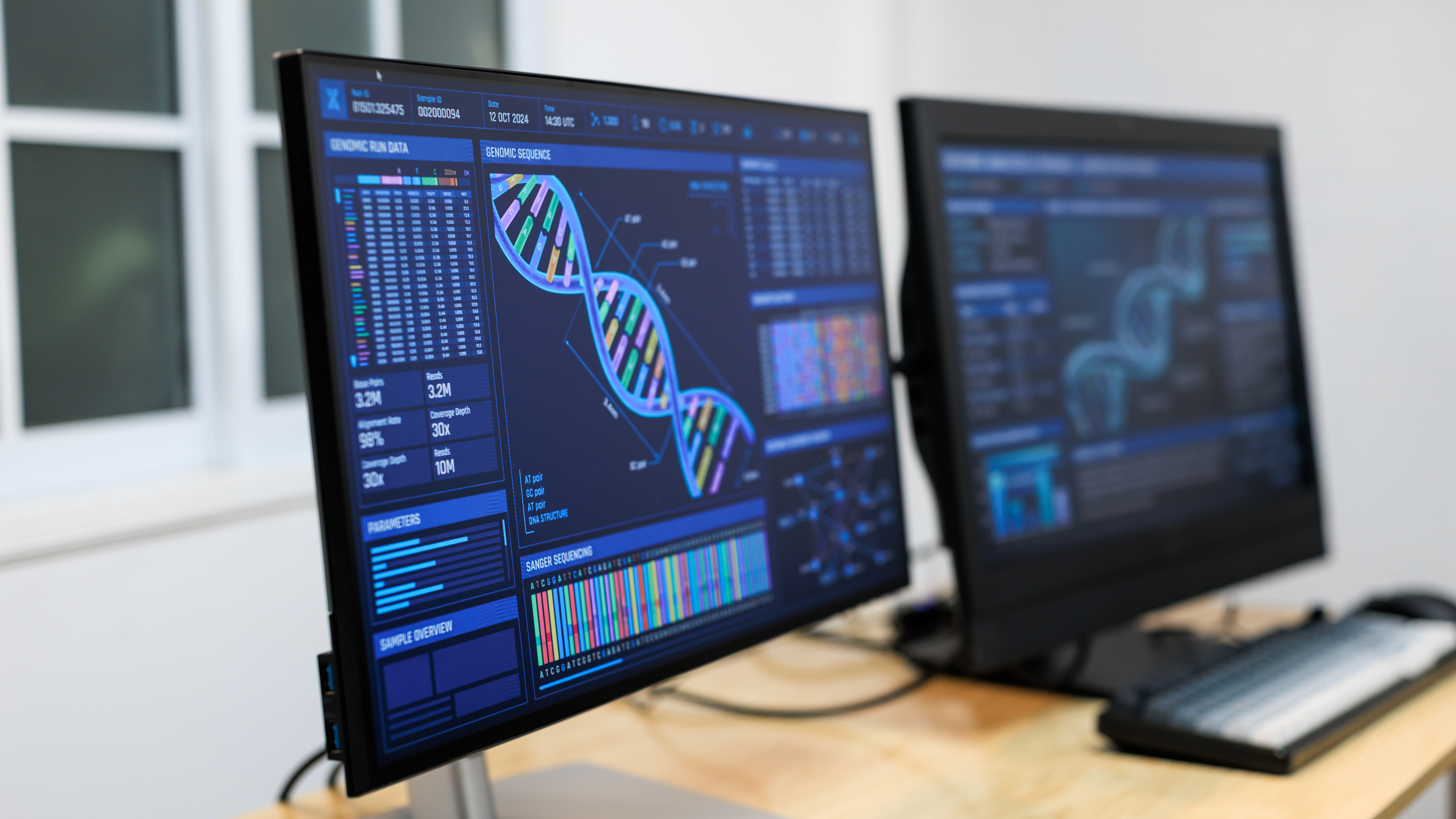
Understanding the Genome and Transcriptome
Living organisms depend on coordinated molecular processes that allow cells to preserve genetic information, respond to their environment, and carry out specialized biological functions. Two closely connected scientific fields, genomics and transcriptomics, help researchers study these processes from complementary perspectives.
Genomics investigates genomes, including their nucleotide sequences, organization, genetic variation, and evolutionary relationships. Genome analysis can reveal genes, regulatory regions, repeated sequences, and structural differences between organisms or individuals. It provides an essential foundation for understanding inherited biological information.
Transcriptomics examines RNA molecules produced from genomic templates. Unlike genomic DNA, which is relatively stable within a cell lineage, transcript abundance changes in response to cell identity, developmental stage, environmental conditions, and biological signals. Transcriptomic measurements therefore provide a view of gene activity at a particular time and under particular conditions.
Combining these perspectives is particularly powerful. A genomic variant may suggest a possible alteration in gene regulation, while RNA analysis can help determine whether transcript abundance or processing differs among samples. Together, these data can support hypotheses about molecular mechanisms that require further experimental investigation.
The genome describes much of a cell's genetic potential. The transcriptome helps reveal which parts of that information are being used.
Genomics vs Transcriptomics
The fields investigate different layers of molecular information. Understanding their differences helps researchers select suitable experimental methods and interpret their results.
| Feature | Genomics | Transcriptomics |
|---|---|---|
| Primary molecule | DNA | RNA |
| Main focus | Genome sequence and variation | Transcript identities and abundance |
| Common methods | Whole-genome, exome, and targeted DNA sequencing | Bulk RNA-seq and single-cell RNA-seq |
| Typical analysis | Alignment, assembly, variant calling, annotation | Quantification, differential expression, transcript analysis |
| Biological question | What genetic information is present? | Which transcripts are expressed, and how abundantly? |
How Genomic Data Reveal Biological Variation
Sequencing technologies allow researchers to characterize the DNA of an organism, a cell population, or a selected genomic region. After experimental processing, the resulting reads can be compared with a suitable reference or assembled into longer sequences. Computational analysis then helps identify features such as genes, sequence differences, and genome organization.
Genetic variants include single-nucleotide changes, small insertions and deletions, and larger structural alterations. Their biological significance varies widely. Some have measurable functional effects, while others are neutral or remain incompletely understood. Reliable interpretation requires contextual evidence rather than sequence comparison alone.
Sequence Alignment
Compare DNA sequences with suitable references to investigate sequence similarities and differences.
Variant Analysis
Identify, filter, annotate, and evaluate genetic differences supported by sequencing evidence.
Genome Annotation
Investigate genes, regulatory features, functional regions, and relationships with biological knowledgebases.
RNA Sequencing and the Dynamics of Gene Expression
A genome contains information that may be used differently among cell types and conditions. Transcriptomics explores this variation by measuring RNA molecules. RNA sequencing can characterize expressed transcripts, estimate their abundance, and reveal patterns that differ between biological samples.
In a typical RNA-seq study, RNA is isolated, prepared for sequencing, and converted into digital sequence data. Bioinformatics methods then assess read quality, assign sequences to genes or transcripts, and quantify expression. Statistical approaches can compare abundance between experimental conditions while accounting for biological variation.
Imagine a study comparing plants exposed to drought with plants grown under well-watered conditions. Transcriptomic analysis may identify changes in RNA abundance associated with stress signaling, water transport, and cellular protection. These patterns suggest candidate processes for further physiological and molecular study.
Single-cell transcriptomics extends these approaches by examining RNA profiles from individual cells. It can reveal cellular heterogeneity that would be obscured when measurements from many different cell types are combined into one sample.
Computational Workflows for DNA and RNA Data
A reproducible analysis connects experimental measurements with biological interpretation. The individual steps vary according to the research objective and data characteristics.
Genomics Workflow
Transcriptomics Workflow
These are conceptual workflows. Actual processing, statistical methods, and validation requirements depend on the sequencing experiment.
Connecting DNA and RNA Analysis to Biological Discovery
Genomics and transcriptomics are widely used to investigate biological variation and function. Their combined value emerges when researchers connect genetic information with the molecular activities of cells and tissues.
Molecular Mechanisms
Study genomic variation and RNA expression patterns associated with biological conditions, disease mechanisms, and cellular responses.
Plant Adaptation
Investigate genetic diversity, stress-associated gene activity, and molecular pathways relevant to crop research and plant development.
Microbial Function
Characterize microbial genomes and transcriptional responses to investigate adaptation, metabolism, and biological diversity.
The relationship between genetic variation and gene expression is not always direct. Environmental influences, epigenetic regulation, RNA processing, and protein-level mechanisms can modify cellular outcomes. Integrating different molecular datasets and experimental evidence therefore provides a more complete basis for scientific discovery.
Explore Genomics and Transcriptomics Resources
Discover established scientific resources supporting genomic annotation, sequence analysis, and gene expression research.
NCBI
Biological sequences, genome information, functional genomics datasets, and literature.
Visit Resource ↗Ensembl
Reference genomes, gene models, transcripts, and comparative annotations.
Visit Resource ↗EMBL-EBI Training
Scientific learning resources for genome analysis and RNA-seq methods.
Visit Resource ↗From Genetic Information to Biological Understanding.
Genomics reveals the information encoded in DNA. Transcriptomics explores how that information is expressed. Together, they help scientists investigate the molecular processes that connect genes with living systems.
Explore BioInfoData →