GENETIC RESEARCH
Inherited Variation
Whole-exome and whole-genome sequencing help researchers investigate candidate variants and the genetic architecture of inherited conditions.
BIOINFODATA / GENOMIC TECHNOLOGIES
Every sequencing experiment produces a molecular record. Bioinformatics transforms that record into biological evidence—revealing genetic variation, gene activity, genome organization, and the mechanisms underlying living systems.
01 / THE SCIENTIFIC FOUNDATION
Next-generation sequencing (NGS) refers to high-throughput technologies capable of determining the nucleotide sequences of many DNA fragments in parallel. Compared with conventional Sanger sequencing, which typically analyzes individual DNA templates, massively parallel sequencing makes it possible to investigate entire genomes, exomes, transcriptomes, and complex microbial communities on a much larger scale.
The sequencing instrument is only one part of the scientific process. Data must also be inspected, processed, aligned or assembled, quantified, and interpreted. The choice of computational approach depends on the experimental question: identifying a genetic variant requires a different analytical strategy from measuring gene expression or reconstructing a microbial genome.
Study substitutions, insertions, deletions, structural variation, and genome organization.
Measure transcript abundance, investigate splicing, and compare biological conditions.
Characterize microbial diversity, genomic content, and community functions.

02 / FROM SIGNAL TO SCIENCE
A reliable NGS pipeline is a sequence of computational decisions. Each stage transforms the data while preserving information about its quality, origin, and processing history.
In reference-guided DNA analysis, sequencing reads are mapped against a reference genome and examined for evidence of sequence differences. In RNA-seq experiments, reads or fragments are instead assigned to genes or transcripts and summarized as expression measurements. In de novo genome assembly, overlapping sequence information is used to reconstruct longer genomic regions without requiring an equivalent reference.
Although these workflows share initial quality-control principles, their analytical endpoints, assumptions, file formats, and interpretation requirements differ substantially.
03 / DATA INTEGRITY
Most sequencing workflows begin with FASTQ files, which contain sequence reads and associated base-quality scores. A quality score expresses the estimated probability that a called base is incorrect. For example, a Phred quality score of Q30 corresponds to an estimated error probability of 0.001, or one error per 1,000 bases, under the quality-score model.
Quality-control analysis explores whether read lengths, sequencing-quality patterns, adapter content, sequence composition, and possible contamination are consistent with the experimental protocol. Adapter trimming, read filtering, and other preprocessing decisions should be appropriate for the library type. Aggressive filtering may remove valid biological information, especially from unusual or low-complexity libraries.
| Quality metric | What it describes | Why it matters |
|---|---|---|
| Base-quality distribution | Confidence assigned to nucleotide calls | Indicates where read accuracy may be reduced |
| Adapter content | Presence of library-preparation sequences | May indicate material requiring trimming |
| Read duplication | Frequency of identical or near-identical reads | Requires interpretation in the context of library complexity and assay design |
| Mapping rate | Proportion of reads aligned to a reference | Can reveal reference mismatch, contamination, or technical problems |
04 / REFERENCE-GUIDED DISCOVERY
Read alignment determines where a sequencing read most plausibly originates within a reference sequence. The resulting alignments contain information about genomic position, alignment confidence, and differences relative to the reference. Alignment records are commonly stored in SAM, BAM, or CRAM formats, depending on the workflow.
Once alignment quality has been assessed, variant calling can identify candidate differences such as single-nucleotide variants (SNVs) and short insertions or deletions (indels). Specialized methods may also detect copy-number changes and larger structural variants. Variant detection is influenced by sequencing depth, read quality, regional mappability, assay design, ploidy, and the chosen computational model.
Variant annotation adds biological context by connecting variants to genomic features, predicted molecular consequences, population-frequency information, and available scientific evidence. An annotated variant is not automatically pathogenic or functionally significant; interpretation requires carefully evaluated evidence and the context of the research question.

A variant call is a computational assessment that a sample differs from a reference at a specific position or region. Its reliability depends on the supporting reads and analysis conditions. Its biological significance is a separate question addressed through annotation, additional evidence, and, when appropriate, experimental validation.
05 / THE EXPRESSED GENOME
Whereas DNA sequencing investigates genomic sequence, RNA sequencing (RNA-seq) provides a view of RNA molecules present in a biological sample. In common bulk RNA-seq workflows, RNA is converted into sequencing libraries, processed, and quantified to estimate the abundance of genes or transcripts.
The central question may be whether a gene changes expression between treated and untreated cells, whether an RNA isoform becomes more abundant during differentiation, or how a tissue responds to an environmental challenge. Read counts alone are not sufficient for robust comparison: library-size differences, transcript length where relevant, biological variability, batch effects, and the experimental design must be considered.
Differential expression analysis uses statistical models to identify genes whose expression differs between experimental conditions while accounting for variation and multiple testing. Downstream enrichment analysis can place these results into the context of molecular functions, biological pathways, and cellular processes. Such associations generate hypotheses; they do not, by themselves, establish causation.
Which genomic sequence differences are present, and what evidence supports them?
Which transcripts are expressed, and how does their abundance vary between samples?
06 / TECHNOLOGY COMPARISON
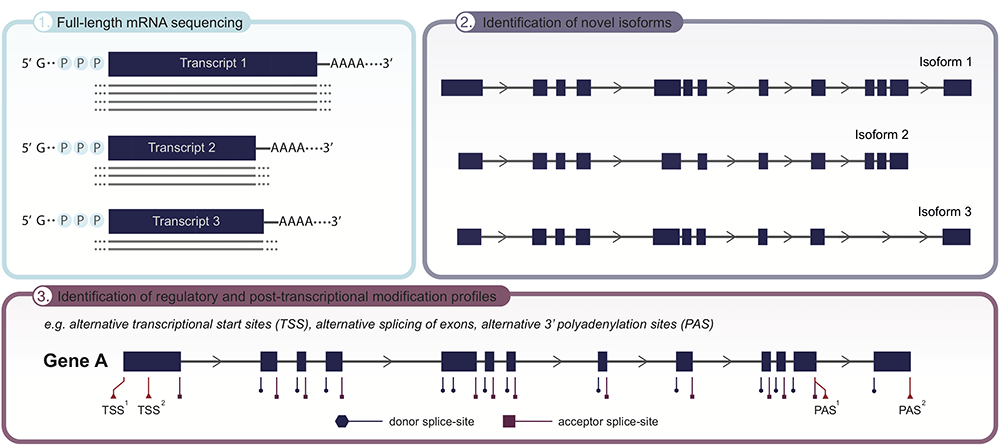
Sequencing read length changes what can be observed directly. Short-read methods generate large numbers of relatively short fragments, often supporting high-throughput variant discovery and expression measurement. Long-read approaches can span repetitive regions, structural rearrangements, and full-length RNA isoforms that are difficult to reconstruct from short fragments. Performance and accuracy depend on the technology, chemistry, and analysis pipeline, so method selection should follow the biological objective.
| Characteristic | Short-read sequencing | Long-read sequencing |
|---|---|---|
| Typical read scale | Tens to hundreds of bases | Thousands to tens of thousands of bases or more |
| Common strengths | High-throughput quantification and small-variant analysis | Structural variation, repeat resolution, transcript isoforms |
| Analysis challenges | Ambiguous mapping and fragmented reconstruction in complex regions | Technology-dependent errors, coverage, and computational demands |
| Illustrative applications | Exome analysis, bulk RNA-seq, targeted panels | Structural variant analysis, genome assembly, full-length RNA isoforms |
07 / BIOLOGICAL APPLICATIONS
The greatest value of sequencing comes from connecting molecular observations to a carefully designed scientific question. Different fields use related technologies to study very different biological systems.
Whole-exome and whole-genome sequencing help researchers investigate candidate variants and the genetic architecture of inherited conditions.
Comparative analysis of tumor and reference material can reveal somatic variants, copy-number changes, and tumor-associated molecular patterns.
RNA-seq reveals expression changes associated with cell signaling, differentiation, experimental treatments, and environmental stress.
Sequencing supports microbial genome reconstruction, comparative genomics, and investigation of genetic diversity across organisms.
Environmental sequencing helps characterize microbial communities and investigate their genomic potential.
Genomic and transcriptomic analysis contributes to research on engineered organisms, microbial production systems, and molecular pathways.
08 / RELIABLE COMPUTATIONAL RESEARCH
A scientifically defensible analysis depends on more than obtaining an output file. Research teams must know which reference genome, software versions, processing parameters, sample identifiers, and quality thresholds were used to generate a result. Without this provenance, two analyses of the same experiment may be difficult to compare or reproduce.
Experimental metadata are equally important. Biological replicates, tissue origin, sampling conditions, batch membership, and relevant treatment details help determine whether observed differences reflect biology or confounding factors. Data governance and access control are particularly important when sequencing datasets contain human genetic information.
09 / PRACTICAL DATA LITERACY
Understanding the purpose of common file formats makes a sequencing workflow easier to navigate. These formats represent different layers of evidence—from raw nucleotide calls to alignments and interpreted genomic variation.
| File format | Primary contents | Typical role |
|---|---|---|
| FASTQ | Read sequences and quality scores | Initial sequencing output |
| FASTA | Nucleotide or protein sequences | Reference sequences and assemblies |
| SAM / BAM / CRAM | Read alignments and associated metadata | Mapping assessment and downstream analysis |
| VCF | Variant sites and supporting fields | Variant reporting and filtering |
| GTF / GFF3 | Genomic feature annotations | Gene models and transcript coordinates |
10 / EXPLORE FURTHER
Public scientific repositories, training resources, and documented analytical methods are central to transparent genomic research.
SCIENTIFIC QUESTIONS / CLEAR ANSWERS
NGS data analysis is the computational processing and interpretation of high-throughput sequencing data. It may involve read quality assessment, mapping or assembly, variant discovery, gene-expression quantification, and functional interpretation.
FASTQ stores sequence reads and their quality scores. BAM is a compressed binary format commonly used to store read alignments, including their positions relative to a reference.
No. Whole-exome sequencing enriches and sequences primarily protein-coding regions, whereas whole-genome sequencing aims to examine genomic DNA more broadly, including coding and noncoding regions. Both have assay-specific coverage limitations.
Low-quality bases, technical artifacts, contamination, and poorly aligned reads can produce misleading evidence. Quality control helps researchers evaluate whether the data support reliable downstream analysis.
Yes. RNA-seq measures the relative representation of RNA transcripts in sequencing libraries. Statistical analysis can then investigate differences in transcript abundance across biological samples or conditions.
THE BROADER SCIENTIFIC CONTEXT
NGS has expanded the scale at which biological systems can be investigated. Yet the essential scientific challenge remains unchanged: translating measurements into meaningful, reproducible explanations. Genomic evidence becomes more informative when combined with transcriptomics, proteomics, network biology, and carefully designed experiments. This integration connects next-generation sequencing to modern biotechnology, systems biology, and molecular discovery.