BIOINFODATA / INTEGRATIVE BIOLOGY
Systems Biology & Biological Networks
Biology is more than a collection of molecules. Discover how the relationships between genes, proteins, metabolites, and cells produce the behavior of living systems.
Explore Biological Networks →01 / UNDERSTANDING COMPLEXITY
What Is Systems Biology?
Systems biology studies living organisms by examining the interactions among their components and how those interactions change over time. Where a reductionist experiment may investigate a single gene or protein, a systems approach asks how multiple molecular components cooperate, compensate, or respond to perturbations.
For example, blocking one signaling protein may alter a network of downstream genes rather than producing a single isolated effect. Understanding the response requires knowledge of molecular interactions, feedback, alternative pathways, and the biological conditions in which the experiment occurs.
The field brings together molecular biology, bioinformatics, mathematics, statistics, and computational modeling. Its central goal is to create explanations that connect measured molecular data with observable biological behavior.
Components
Genes, RNAs, proteins, metabolites, and other molecular entities that participate in biological functions.
Interactions
Physical contacts, regulatory relationships, biochemical reactions, and statistical dependencies.
Dynamics
Changes in molecular activity across time, environmental conditions, and experimental perturbations.
02 / NETWORK ARCHITECTURE
Types of Biological Networks
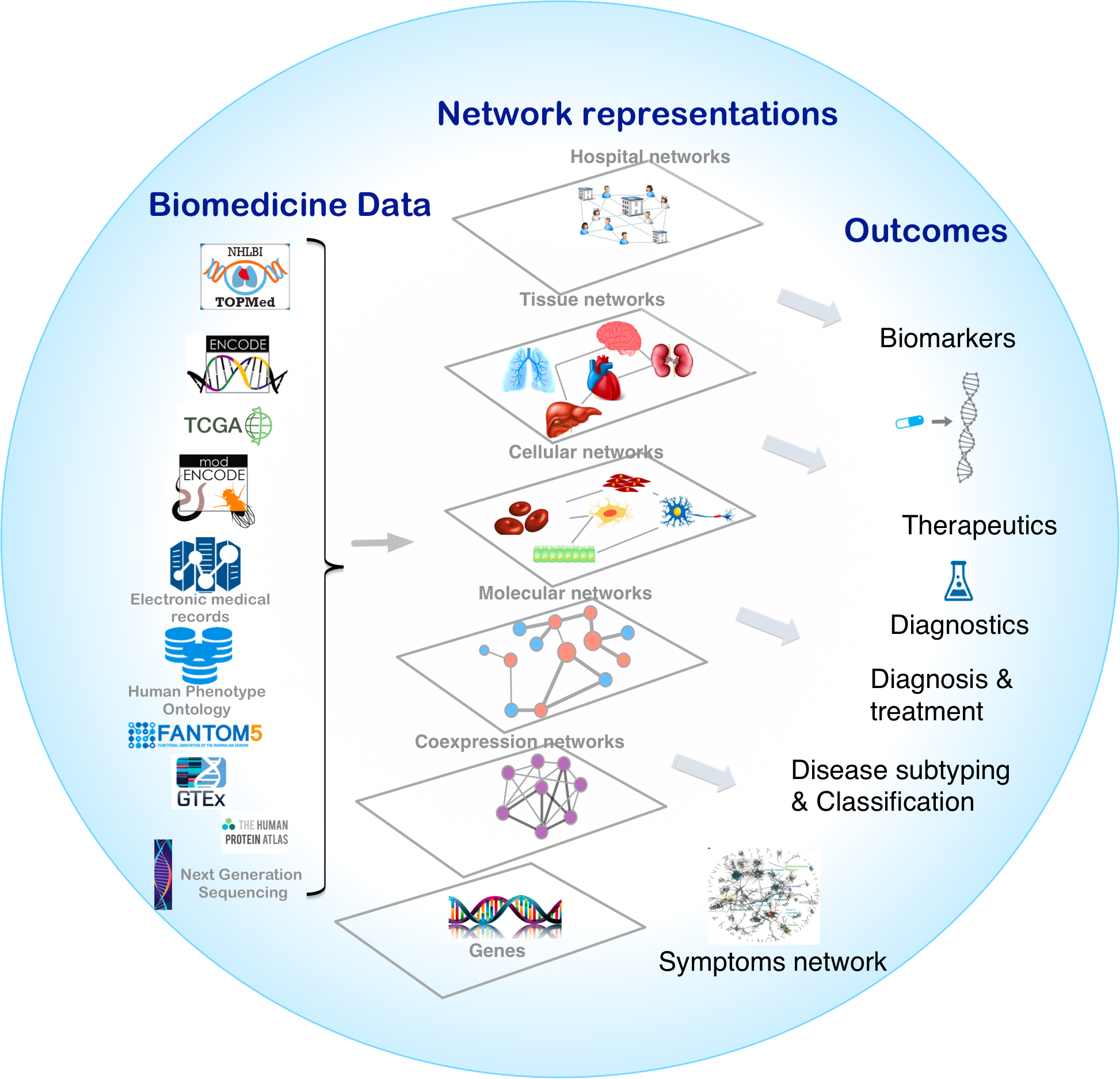
Biological networks are often represented as graphs. A node represents an entity such as a gene, protein, or metabolite, while an edge describes a relationship. However, the meaning of an edge depends on the network: physical interaction, statistical correlation, regulatory influence, and metabolic conversion are not interchangeable.
| Network type | What edges represent | Example research question |
|---|---|---|
| Protein interaction | Physical or functionally associated proteins | Which proteins participate in a cellular process? |
| Gene regulatory | Regulatory relationships between genes or regulators | Which transcription factors influence gene expression? |
| Co-expression | Statistical similarity between expression profiles | Which genes change together across samples? |
| Metabolic | Biochemical reactions and metabolite relationships | How does material flow through cellular metabolism? |
| Signaling | Molecular information transfer | How does an external stimulus produce a cellular response? |
A key distinction: two genes with correlated expression are not necessarily in a direct regulatory relationship. Network inference generates hypotheses that require further evidence.
03 / PATHWAYS AND REGULATION
How Molecular Pathways Produce Cellular Responses
Cellular behavior often emerges from interactions among pathways. Growth-factor signaling, for example, can involve receptor activation, phosphorylation cascades, transcription-factor activity, and altered expression of genes controlling proliferation or survival. Feedback loops may amplify a response, limit it, or allow a system to return toward a stable state.
A pathway diagram usually represents established mechanistic steps, while a network may contain a broader set of associations supported by different evidence types. Pathway enrichment tests whether a list of genes or proteins is disproportionately associated with known biological processes. Its conclusions depend on the selected background, annotations, statistical procedures, and study design.
04 / NETWORK DATA ANALYSIS
From Omics Datasets to Network Models
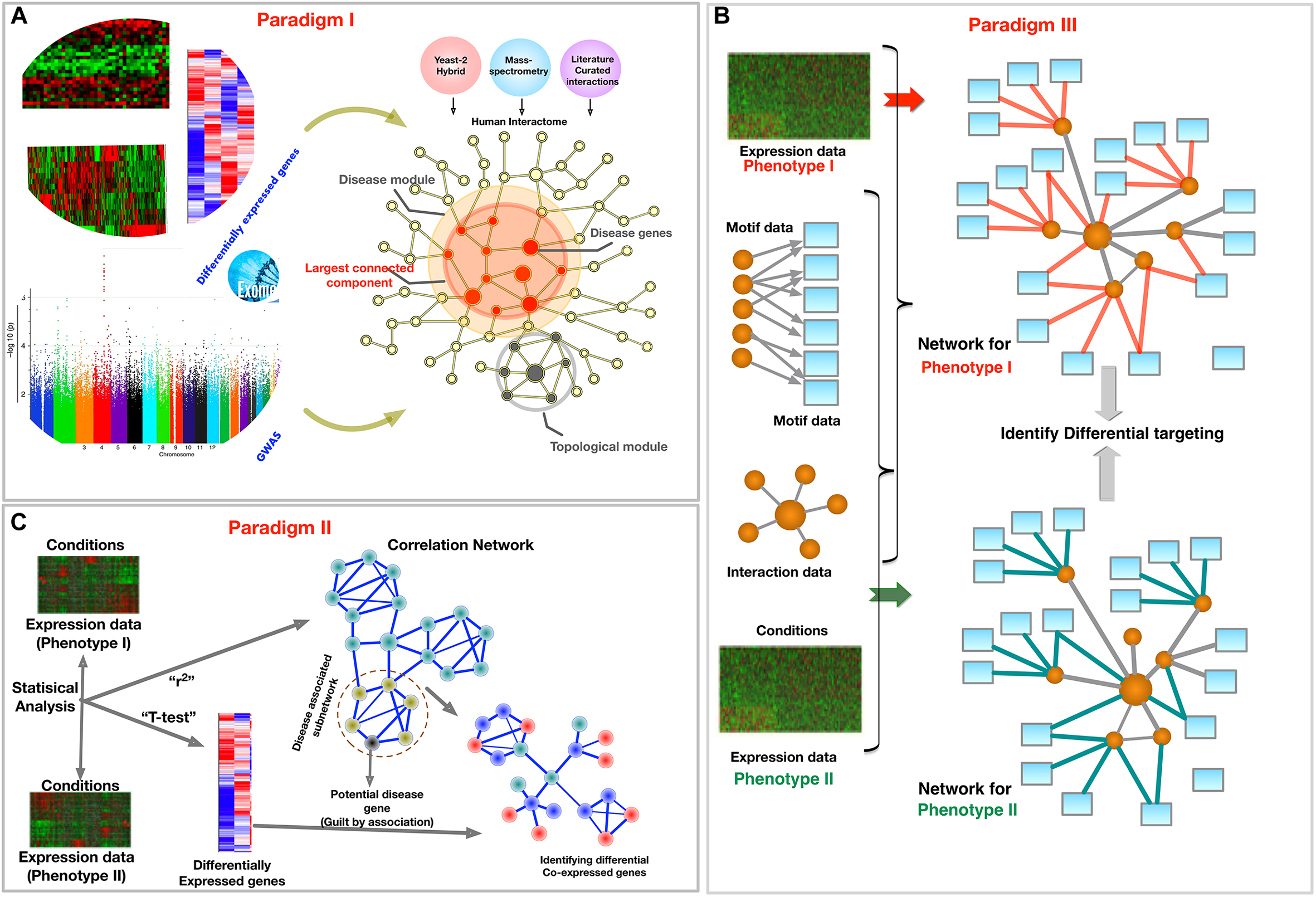
Network construction can begin with experimentally characterized molecular interactions, curated databases, or relationships estimated from high-throughput measurements. An RNA-seq study might reveal genes with correlated expression patterns; proteomics can provide information about protein abundance or interactions; metabolomics can supply measurements that constrain biochemical pathways.
After constructing a network, researchers examine modules, connectivity, functional annotations, and differences across conditions. Highly connected nodes, sometimes called hubs, can be informative, but connectivity alone does not demonstrate that a node is essential or causally responsible for a phenotype. Dataset biases and uneven coverage of well-studied molecules can strongly affect network structure.
05 / MATHEMATICAL BIOLOGY
Dynamic Models, Simulations & Metabolic Flux
A network describes relationships; a dynamic model asks how a system may behave. Ordinary differential equations can represent changes in molecular concentrations over time, Boolean models simplify molecular states into discrete values, and constraint-based metabolic models examine feasible reaction fluxes under defined assumptions.
For instance, flux balance analysis uses the stoichiometry of metabolic reactions together with constraints and an objective function to investigate possible steady-state flux distributions. It does not directly measure fluxes, and predictions depend on the model's assumptions. In a different setting, a kinetic model of a signaling pathway can help investigate whether negative feedback might explain an observed response to stimulation.
| Model approach | Best suited to | Important limitation |
|---|---|---|
| Differential equations | Continuous dynamic processes | May require parameters difficult to measure |
| Boolean networks | Qualitative regulatory states | Simplifies continuous molecular behavior |
| Constraint-based models | Metabolic capabilities and flux distributions | Dependent on constraints and modeling objectives |
06 / INTEGRATED BIOLOGICAL EVIDENCE
Multi-Omics Integration
Genomics describes sequence variation, transcriptomics measures RNA abundance, proteomics investigates proteins, and metabolomics characterizes small molecules. These layers are related but are not interchangeable. Messenger RNA abundance, for example, does not always predict protein concentration because translation, degradation, and other regulatory processes influence protein levels.
Systems-level integration can compare molecular layers, identify coordinated changes, and support hypotheses about mechanisms. Multilayer networks provide one way to represent interactions both within and between omics types. Their usefulness depends on appropriate normalization, sample matching, biological context, and statistical validation.
07 / SCIENTIFIC APPLICATIONS
Systems Biology in Modern Research
In disease research, network analysis can connect molecular disturbances to cellular processes and support the prioritization of candidate biomarkers or research targets. In microbiology and biotechnology, metabolic models help investigate how changes in nutrient availability or genetic pathways could influence organismal behavior. In plant biology, regulatory networks can be used to study responses to stress, development, and environmental signals.
The most convincing applications combine computational predictions with new evidence. A network-derived hypothesis about a regulatory protein can be tested by perturbing that protein and measuring downstream molecular responses. This process turns computational patterns into experimentally testable biological explanations.
From association to mechanism
A well-supported network connection may suggest a biological relationship. Demonstrating that the connection causes a specific cellular outcome generally requires additional experimental design, interventions, and validation.
08 / METHODS AND TOOLS
Useful Resources for Network Biology
09 / COMMON QUESTIONS
Systems Biology FAQs
What is the difference between systems biology and bioinformatics?
Bioinformatics develops and applies computational methods to biological data. Systems biology uses experimental and computational approaches to understand how biological components interact and produce system-level behavior. The fields overlap extensively.
What is a gene regulatory network?
It is a representation of relationships through which regulatory molecules influence gene expression. Some interactions are experimentally established, while others are inferred from observational datasets.
What is pathway enrichment analysis?
It is a statistical approach for evaluating whether genes or proteins associated with a study are overrepresented in annotated biological pathways or functional categories.
10 / THE BIG PICTURE
Understanding Life as an Interconnected System
Systems biology provides a framework for moving from molecular measurements toward explanations of cellular behavior. By combining pathway knowledge, high-throughput data, quantitative models, and experimental validation, it supports discoveries in biotechnology, molecular medicine, microbial engineering, and many other fields.